 Harvey Fang
Making Sense of the Complexity
Across Product, Data, and Engineering, teams were exploring capabilities around benchmarks, People Like You (PLY), longitudinal data, enrichment, and recommendations. Each had its own technical architecture, dependencies, and roadmap. I worked through engineering diagrams, technical documentation, and conversations with stakeholders to understand how these initiatives fit together and where opportunities overlapped. What emerged was a vision for a connected intelligence layer that could bring these capabilities together and deliver meaningful insights throughout the SurveyMonkey experience.
Connecting the Customer Journey
With a clearer understanding of the underlying capabilities, I mapped how intelligence could support customers from survey creation through analysis and taking action. The journey map helped identify opportunities to introduce intelligence at meaningful moments, from recommending relevant surveys and questions to providing context around results, surfacing trends, and suggesting next steps. It also helped connect the different initiatives into a cohesive experience, becoming a shared reference for Design, Product, Data, and Engineering as we worked toward a common vision.
Defining the Anatomy of an Insight
As we began connecting the different capabilities, a fundamental question emerged: what actually makes something an insight? I developed the Anatomy of the Insight Experience to establish a shared framework for how insights could be generated, enriched with context, and delivered to customers. The framework consists of three layers:
- Finding: Something noteworthy in the data, such as a change, pattern, or potential risk.
- Intelligence: Context from benchmarks, historical trends, and similar organizations that helps explain why a finding matters.
- Experience: Supporting evidence, recommendations, and conversational tools that help customers understand, trust, and act on an insight.
The framework gave Design, Product, Data, and Engineering a common language for defining insights and a foundation for building consistent experiences across the product.
Bringing the Vision Into the Product
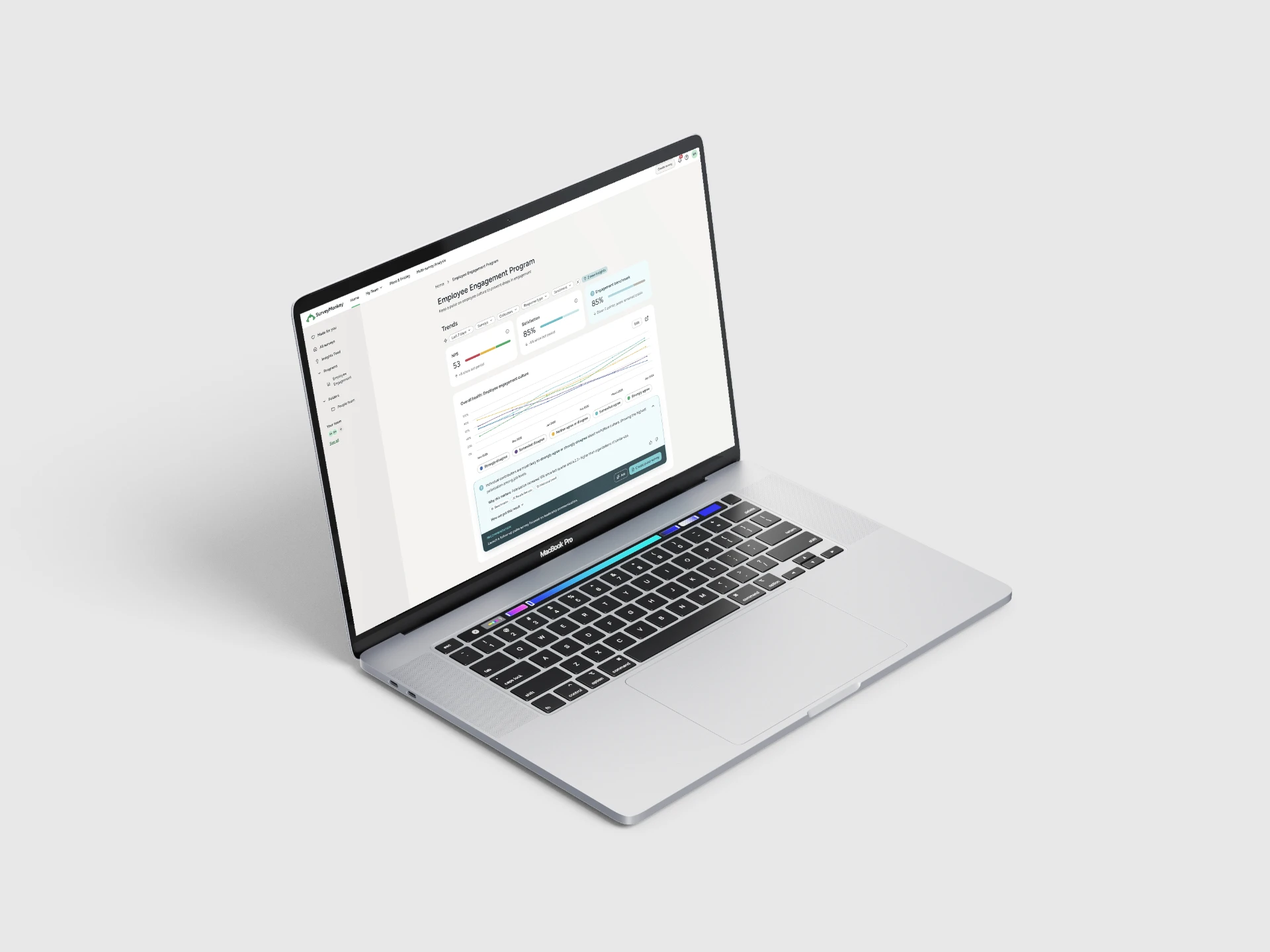
With the journey and insight framework in place, I began exploring how the vision could come to life across different parts of SurveyMonkey. I developed concepts and working prototypes that brought intelligence into experiences such as survey creation, Analyze, Programs, and the product's entry points. The goal wasn't to introduce another dashboard or a separate AI destination. It was to make intelligence feel like a natural part of the existing experience, appearing when it could help customers understand something, make a decision, or take action.
Outcomes and Learnings
While Data as a Moat is still an evolving initiative, the work has already helped establish a shared direction across the organization. The customer journey map and anatomy of an insight have become important reference artifacts for Design, Product, Data, and Engineering, helping teams connect their individual initiatives to the larger product vision. The work is also informing ongoing efforts in Benchmarks, Programs, and Analyze as those teams begin bringing different parts of the strategy into the product.
One of my biggest takeaways was the value of design in making complex ideas understandable. The challenge wasn't necessarily coming up with another feature or interface. It was bringing together a wide range of technical capabilities, business priorities, and customer needs into something people could understand, align around, and build toward.